
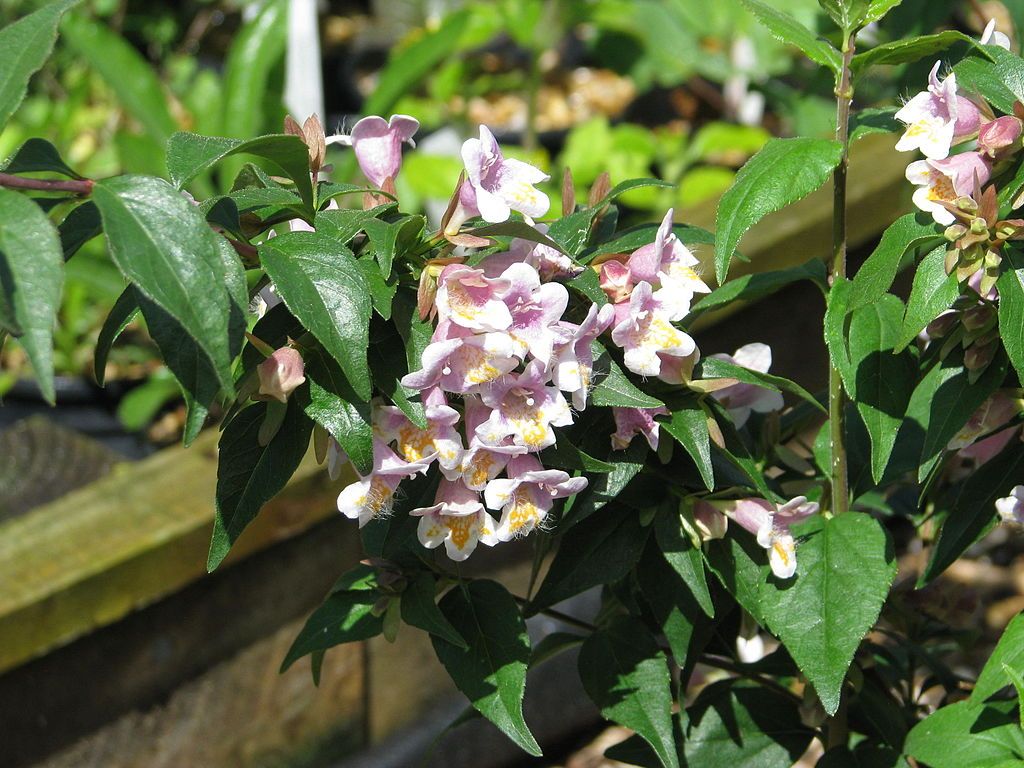
Engler’s abelia (Abelia engleriana) is a shrub that can grow 1.5m – 3m tall and 1.5m – 3m wide. In this growing guide we’ll learn the cultivation details and how to plant Engler’s abelia (Abelia engleriana).
This plant is commonly known as Engler’s abelia.
This is a semi-evergreen plant that takes 10-20 years to reach full maturity.
In this article
Plant profile
Common name: Engler’s abelia
Scientific name: Abelia engleriana
Plant type: Shrubs
Habit: Bushy
Height: 1.5m – 3m
Spread: 1.5m – 3m
Foliage: Semi-evergreen
Sunlight: Full Sun
Soil: Chalk, Loam, Sand
Moisture: Moist but well drained
Garden type: City & Courtyard Gardens, Informal Garden
Planting type: Flower borders and bedding, Low Maintenance, Wall-side Borders
Seasonal colors
| Season | Stem | Foliage | Flower | Fruit |
|---|---|---|---|---|
| Spring | ||||
| Summer | ||||
| Autumn | ||||
| Winter |

How to plant Engler’s abelia (Abelia engleriana) – peganum from Small Dole, England, CC BY-SA 2.0, via Wikimedia Commons
Shrubs are fundamental elements in any garden.
They add color and interest throughout the seasons with their wide variety of flowers, foliage, fruits, trunks and stems.
Whatever the size or style of your garden, the permanent woody structure or the foliage of evergreen shrubs will give the space shape and dimension.
How to plant
In this section we will learn how to plant Engler’s abelia (Abelia engleriana), know its needs in terms of soil, watering and sun exposure.
Soil
Engler’s abelia (Abelia engleriana) is not a demanding plant regarding the type of soil and can grow in chalk, loam or sand.
-
The chalky soil is pale and contains chunks of calcium-rich rock. It is a fertile and well-draining soil, almost always alkaline.
-
The loam soil is dark, rich in organic matter but balanced in minerals. It offers the best of all worlds, retaining enough water for the plants, but allowing excess moisture to drain away. This is the most desired type of garden soil, perfect for most plants.
-
Sandy soil is light, porous and very easy to drain. It is a soil poor in organic matter and nutrients. It is composed of relatively large mineral particles that allow water to drain quickly.
It is not very sensitive to soil acidity or alkalinity and grows well in soils with pH acid, alkaline or neutral.
Regarding drainage, Abelia engleriana likes to grow in moist but well drained soil.
Sunlight
Engler’s abelia (Abelia engleriana) should be grown in full sun places.

Cultivation profiles – Growing Engler’s abelia (Abelia engleriana) – peganum from Small Dole, England, CC BY-SA 2.0, via Wikimedia Commons
.jpg)
.jpg)